Locations: Estonia: Aidu, Lasnamäe, Saaremaa.
Japan: Tokyo. China: Chongqing
Japan: Tokyo. China: Chongqing
Secret life of gardens
Group Exhibition in Kumu Art Museum Tallinn, Estonia
Summer to Autumn 2013
Curator: Eha Komissaarov
Coauthor: Mihkel Tüür
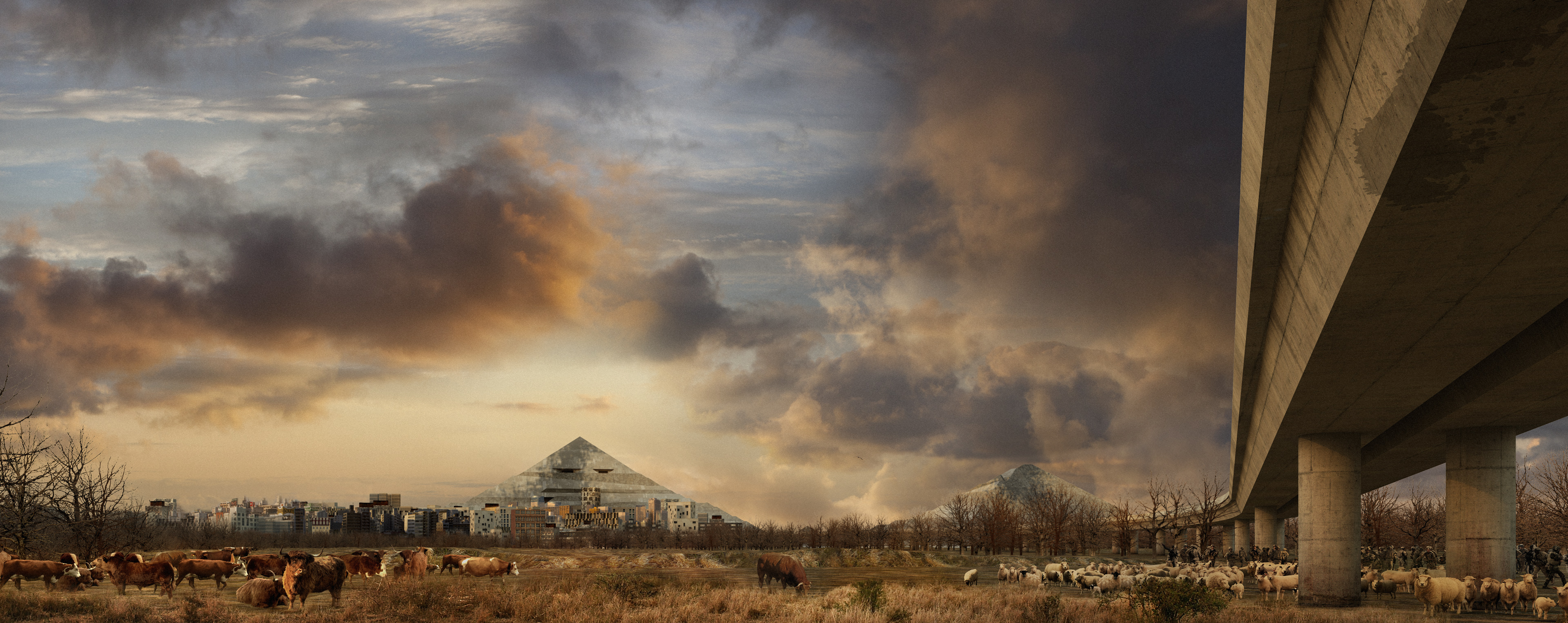
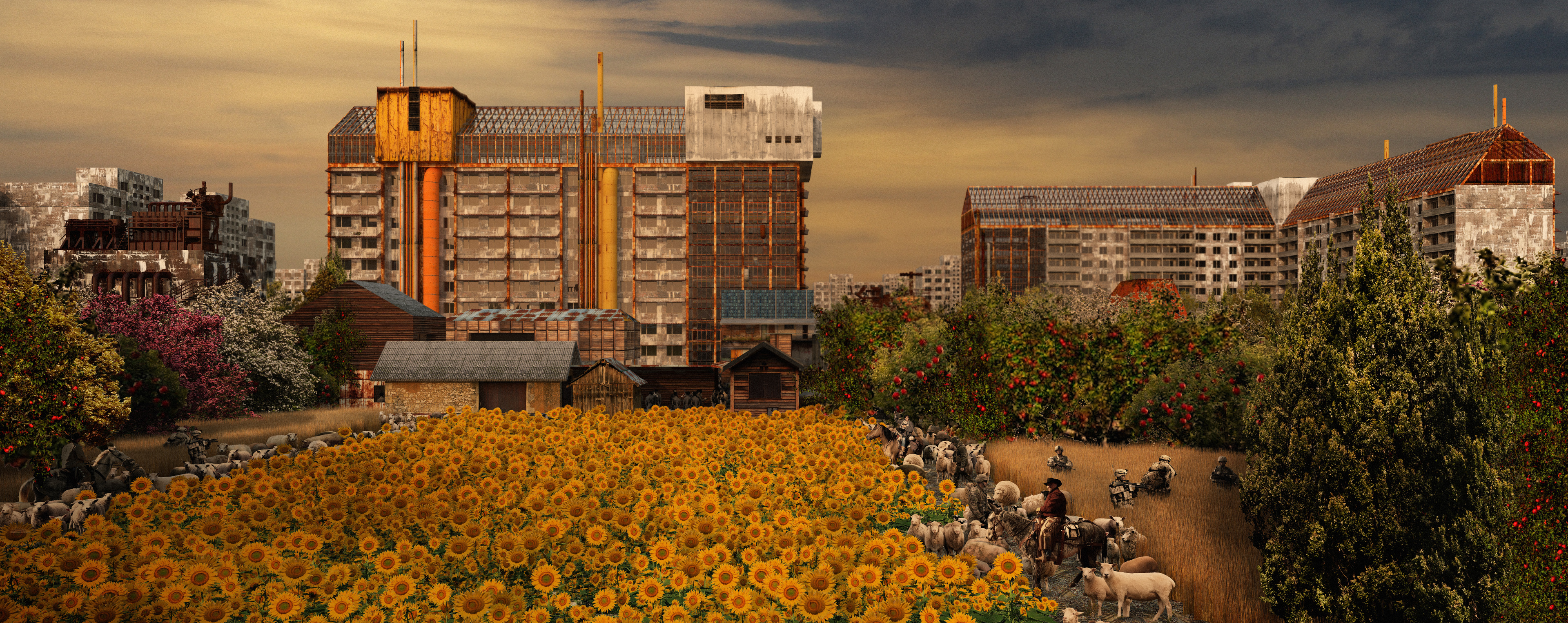
Illustrations for two different projects by KTA. Both of them describe the possible future of places in Estonia.
The works of Kadarik Tüür Architects, presented in the exhibition Secret Life of Gardens, examine landscapes and urban environments as phenomena shaped by social and historical change. Rather than promoting nostalgic restoration or envisioning linear progress, these projects operate within a speculative framework where decline, interruption, and the potential for regeneration coexist.
Makrorajoon and Aidu Pyramid are predicated on the observation that large-scale spatial transformations often surpass the pace of social adaptation. Within less than a century, extensive territories have been reshaped by technological optimization and resource efficiency, producing environments in which social functions are increasingly diminished. These conceptualizations blur the boundaries between urban and rural, living and non-living, and artificial and natural, resulting in a complex socio-spatial hybrid.
Aidu Pyramid interprets post-mining landscapes as gradual, sedimentary processes rather than sites for immediate rehabilitation. The former industrial area is not restored to an idealized natural state; instead, it is allowed to evolve into a new spatial entity where technological remnants, ecological succession, and architectural memory converge. The pyramid functions not as an isolated object but as a temporally condensed landscape, demonstrating how industrial residue can attain cultural and spatial significance over time.
Makrorajoon envisions Tallinn’s large-scale housing estates projected into a distant future. The panel housing remains but loses its original programmatic clarity, integrating into an expanded landscape system. The architects characterize this condition with the metaphor of a “parking city,” a space with an indeterminate future use. While such environments may deteriorate into wastelands, they also possess the potential for alternative forms of habitation. The primary concern shifts from architectural form to the human position within layers of infrastructure, debris, and residual structures.
As these projects remain unrealized, they primarily exist as conceptual or mental landscapes. They intertwine personal experience and architectural history with collective anxieties and aspirations, producing spatial narratives that may be read as constructed myths, historical discontinuities, or deliberate distortions. Instead of being erased, cultural memory is re-inscribed into future imaginaries in altered forms.
For viewers, these works produce a disruptive experience. They simultaneously signal socially declining landscapes and the erosion of everyday life, while also opening possibilities for new forms of social temporality and spatial practice. Rather than providing solutions, Kadarik Tüür Architects pursue a dialogical inquiry, seeking to conceptualize landscape reanimation at a moment when established models have ceased to function and new paradigms have yet to emerge.
.
Makrorajoon and Aidu Pyramid are predicated on the observation that large-scale spatial transformations often surpass the pace of social adaptation. Within less than a century, extensive territories have been reshaped by technological optimization and resource efficiency, producing environments in which social functions are increasingly diminished. These conceptualizations blur the boundaries between urban and rural, living and non-living, and artificial and natural, resulting in a complex socio-spatial hybrid.
Aidu Pyramid interprets post-mining landscapes as gradual, sedimentary processes rather than sites for immediate rehabilitation. The former industrial area is not restored to an idealized natural state; instead, it is allowed to evolve into a new spatial entity where technological remnants, ecological succession, and architectural memory converge. The pyramid functions not as an isolated object but as a temporally condensed landscape, demonstrating how industrial residue can attain cultural and spatial significance over time.
Makrorajoon envisions Tallinn’s large-scale housing estates projected into a distant future. The panel housing remains but loses its original programmatic clarity, integrating into an expanded landscape system. The architects characterize this condition with the metaphor of a “parking city,” a space with an indeterminate future use. While such environments may deteriorate into wastelands, they also possess the potential for alternative forms of habitation. The primary concern shifts from architectural form to the human position within layers of infrastructure, debris, and residual structures.
As these projects remain unrealized, they primarily exist as conceptual or mental landscapes. They intertwine personal experience and architectural history with collective anxieties and aspirations, producing spatial narratives that may be read as constructed myths, historical discontinuities, or deliberate distortions. Instead of being erased, cultural memory is re-inscribed into future imaginaries in altered forms.
For viewers, these works produce a disruptive experience. They simultaneously signal socially declining landscapes and the erosion of everyday life, while also opening possibilities for new forms of social temporality and spatial practice. Rather than providing solutions, Kadarik Tüür Architects pursue a dialogical inquiry, seeking to conceptualize landscape reanimation at a moment when established models have ceased to function and new paradigms have yet to emerge.





© Ott Kadarik
insta: @kodarik @luidrik @ktarchitects